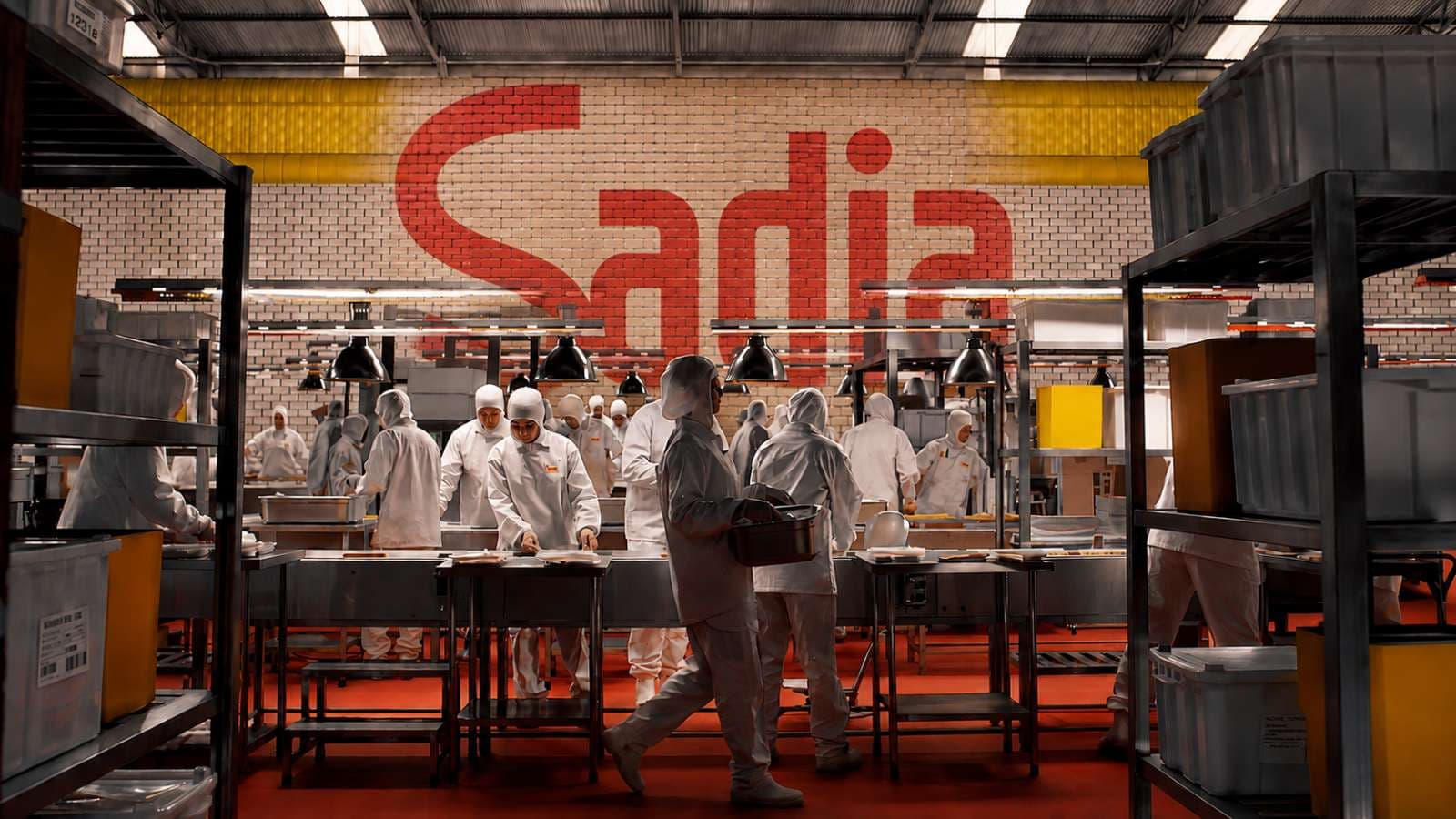
Sadia Case Study: An Open Innovation Platform for R&D Partners
Before writing a single line of code, Agence spent a large share of two separate Sadia projects just understanding the business behind them. That detail explains why the same food industry giant came back for a completely different front: after an open innovation platform for R&D partners, came an internal policy site, built with the same strategic consulting method.
Who is Sadia and why this case matters for other manufacturers
Sadia was founded on June 7, 1944, when Attilio Fontana bought a struggling meat processing plant and created S.A. Indústria e Comércio Concórdia. Shortly after, the company adopted the name Sadia, formed from the initials of Sociedade Anônima plus the last three letters of Concórdia, and registered the brand in 1947. This origin matters because the open innovation platform for R&D partners that Agence built for Sadia, decades later, did not come out of an isolated request. It came from the commitment of a brand with nearly a century of history and continuous research in food products.
Over more than eight decades, Sadia became a quality benchmark in the food industry, both in Brazil and abroad. On May 19, 2009, the company merged with Perdigão and became part of the Brasil Foods group, BRF. Its largest industrial unit sits in Uberlândia, in the state of Minas Gerais, a symbol of the scale the operation reached after the merger. That scale is exactly what makes the case relevant to other large manufacturers: when a company of this size decides to technically structure both external partner capture and internal policy distribution, the path it takes becomes a reference for any organization facing the same growth dilemma.
The challenge: capturing outside innovation while keeping internal governance
A manufacturer the size of Sadia needs a structured channel to attract researchers, scientists and partners willing to collaborate on new frozen products or more durable packaging. This kind of relationship with the outside research ecosystem is the essence of open innovation in the food industry: the company no longer depends solely on its own lab, it opens doors to people outside it. Without an organized platform to receive these proposals, the relationship happens in a scattered way, through email or personal contact, and the company loses traceability over who proposed what and at which stage each proposal stands.
At the same time, independently of that external relationship, Sadia needed to make sure corporate rules and regulations actually reached employees spread across multiple units and departments. Publishing a policy is not the same as making sure it gets read, understood and followed. Capturing outside innovation and distributing internal rules are two faces of the same commitment. A food company that values quality and traceability cannot leave the entry of external ideas, or the circulation of internal rules, to informal processes.
Sadia Innovation Portal: how a corporate innovation portal captured R&D partners
The Sadia Innovation Portal was built to showcase the company's research initiatives, such as new frozen products and packaging designed to extend shelf life, and to attract researchers and scientists interested in forming a partnership. Working as a platform for capturing R&D partners, the portal gave Sadia a single channel for anyone proposing collaboration, replacing scattered contact with a process that had a clear beginning, middle and end, all logged.
Registration and submission
External researchers and scientists registered in the portal's restricted area and submitted partnership proposals directly through the platform.
Process tracking
Each partner tracked their own proposal in the restricted area, without depending on manual contact to find out which stage of evaluation it was in.
Admin panel
Sadia's team used a dedicated panel to evaluate, approve or decline proposals, centralizing decisions that used to be scattered across emails and personal contacts.
The platform was built in PHP, with the CodeIgniter framework, and a MySQL database, a combination typical of robust web projects from the era in which the portal was developed. It is worth noting that this case is presented here with its proper historical context: there is no confirmation that the portal still operates in the same terms today, and the purpose of this article is to show how the project was structured, not to announce an active tool.
This kind of architecture was designed for business logic such as registration, approval workflow and an admin panel. It is the same reasoning that guides Agence's custom web development work today for other manufacturers that need their own platforms instead of generic tools.
Internal Policy and Regulation Site: an internal policy management system without per-machine licensing
The Internal Policy and Regulation Site served a different audience: Sadia employees with access to the corporate intranet, who needed to look up company policies and regulations without relying on printed files or outdated versions circulating by email. The system was built in HTML and JavaScript, a choice that reflects well the kind of content it delivers, information meant for reading and reference, not an approval flow with multiple stages like the Innovation Portal.
This web architecture without per-machine licensing cut infrastructure cost in a way that hits the budget of a company the size of Sadia directly. There was no need to buy a license for every workstation or manage local installation on each computer. When a rule changed, updating the server was enough for every following access, with no manual version distribution at all. This project solved a different problem from another intranet case Agence worked on, focused on unifying internal ticket requests and segmenting access by employee profile, documented in the Honda corporate intranet case study. Here the problem was different: making sure a published rule actually reached the people who needed it, in its current version. It is an example of how corporate governance and technology come together when internal regulation gets the same consulting rigor applied to external innovation.
Why strategic consulting weighed so heavily on both projects
Before any code was written, both Sadia projects went through a strategic IT consulting phase that consumed a significant share of the total effort, second only to technical development itself. In the Innovation Portal, that phase ranked only behind development in PHP and CodeIgniter. In the Policy and Regulation Site, strategic consulting was also the second largest block of work, behind only the HTML interfaces.
That weight signals alignment with Sadia's corporate objectives before any technical decision was made. It is the design of a solution tailored to each business challenge, not the delivery of a programming commodity. A vendor that treats strategic consulting as a secondary step tends to deliver systems that are technically correct but disconnected from what the company actually needs to solve.
Agence structures this same kind of work today through its consulting and prototyping practice for other clients facing similar decisions, mapping business objectives and designing the right solution before writing any code.
Tech stack: PHP, CodeIgniter, MySQL, HTML and JavaScript in practice
Placed side by side, the two projects show how technology choices follow the purpose of the system, not a fixed vendor preference. The Innovation Portal needed business logic: partner registration, a proposal approval workflow and an admin panel with access rules. That called for development in PHP and CodeIgniter, backed by a MySQL database. The Policy and Regulation Site needed mostly content reading and reference, which called for a lean web architecture in HTML and JavaScript, without the weight of a robust back end.
| Criterion | Sadia Innovation Portal | Internal Policy and Regulation Site |
|---|---|---|
| Technology | PHP, CodeIgniter and MySQL | HTML and JavaScript |
| Target audience | External R&D researchers and partners | Employees with intranet access |
CodeIgniter is a framework associated with a period before the current cycle of web technologies, which places both projects at an earlier point in the relationship between Agence and Sadia. That does not diminish the value of the case. If anything, it shows that the underlying methodology stayed consistent over time, even when the technical stack chosen was completely different from one project to the other. That same reasoning, choosing technology by business purpose rather than habit, is what separates a vendor that only writes code from a partner who understands the reason behind every technical decision. If you are facing a similar choice between architectures for your next corporate system, it is worth talking to a team that has already made that call twice with the same client.
What this case reveals about long-term IT outsourcing partnerships
Agence worked with Sadia on two completely distinct business fronts: open innovation, facing outward, and internal governance, facing inward. The technologies used in each project do not repeat, the audience of each system does not repeat, and yet the pattern of work behind both is exactly the same.
The common thread between these two projects is not the technology. It is how much weight strategic consulting carried before any code was written.
This pattern is what sustains recurring relationships between large brands and a single IT vendor, instead of one-off engagements that restart from scratch with every new challenge. When strategic IT consulting already understands a company's culture, approval processes and priorities, the next project starts faster and with less risk of misalignment, even when the technology in use is entirely different.
This kind of partnership, one that holds up year after year with the same IT provider, also shows up in Agence's client testimonials, which gather accounts from companies that chose to keep working with the consultancy across different fronts of their business.
Frequently asked questions about corporate innovation portals
What is a corporate innovation portal and what is it for?
It is a web platform that organizes the capture, evaluation and approval of innovation proposals coming from outside the company, such as researchers, startups or technical partners. It replaces scattered contact by email or occasional meetings with a process built around centralized registration, submission and tracking.
How does open innovation work in the food industry?
It happens when a company opens formal channels to receive external contributions in research on new products, packaging or processes, instead of relying solely on its own internal lab. A structured portal, like Sadia's, makes that relationship possible at scale.
What is the difference between an innovation portal and an internal policy intranet?
An innovation portal serves external audiences proposing research and development partnerships, with an evaluation and approval flow. An internal policy intranet serves the company's own employees and is meant for looking up already approved rules, with no approval workflow involved.
Why use a web architecture instead of a per-machine installed system to distribute internal policies?
Because a web architecture removes the need to buy a license for every workstation, and any content update takes effect immediately for every subsequent access, with nothing to reinstall locally. That lowers infrastructure cost and simplifies maintenance in companies with many units.
Why is strategic consulting an important step in a custom corporate platform project?
In the Sadia case, strategic consulting was the second largest work front on both projects, behind only actual technical development. A significant share dedicated to understanding the business before writing any code is a sign that the solution is being designed to fit, not replicated from a generic template.
Move your project forward with Agence
Just as with Sadia, where strategic consulting was one of the largest work fronts across two projects of completely different natures, Agence starts every new portal or corporate system project by mapping your business before deciding on architecture and stack. If you lead an open innovation or corporate governance initiative and want to structure the right channel for your challenge, talk to the Agence team.